2025 Mercedes-Benz Vision Iconic blends Art Deco curves with AI brains
The 2025 Mercedes-Benz Vision Iconic is a concept that bridges past and future. It brings back classic grand-tourer proportions while integrating cutting-edge technologies such as a photovoltaic body coating, steer-by-wire controls, and neuromorphic computing aimed at next-generation driver-assist systems. In essence, it reinterprets Mercedes’ heritage design language for a fully electric, software-driven era.
Design: a classic face reimagined for electrons
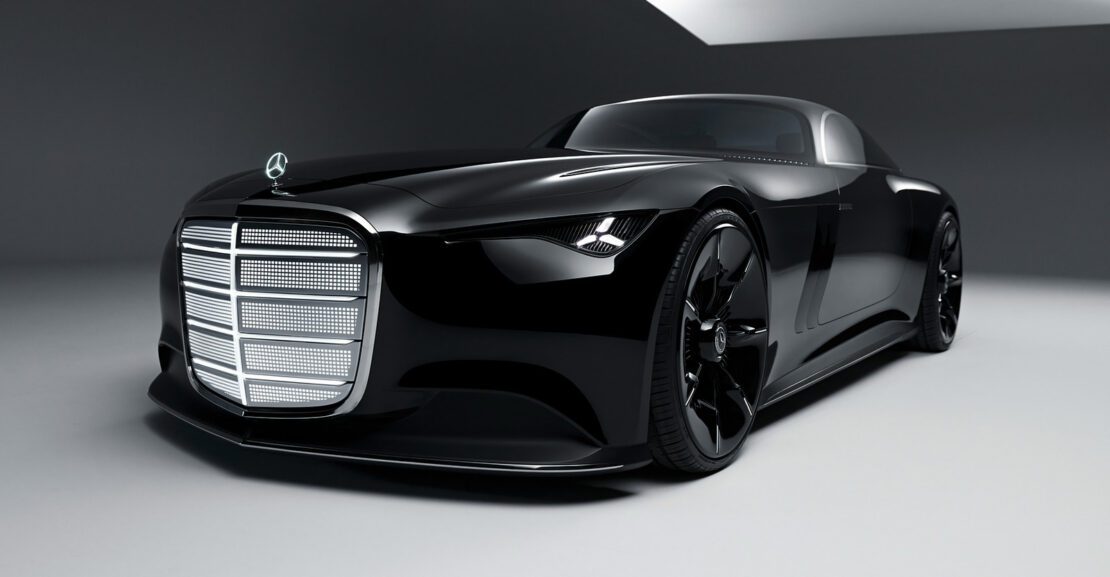
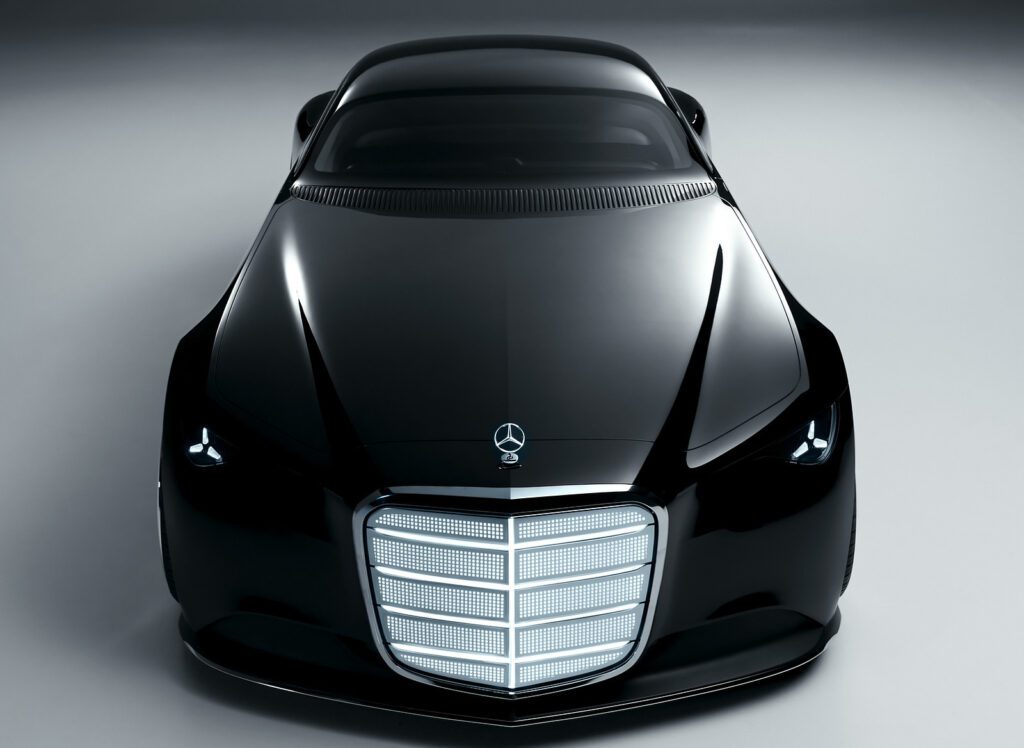
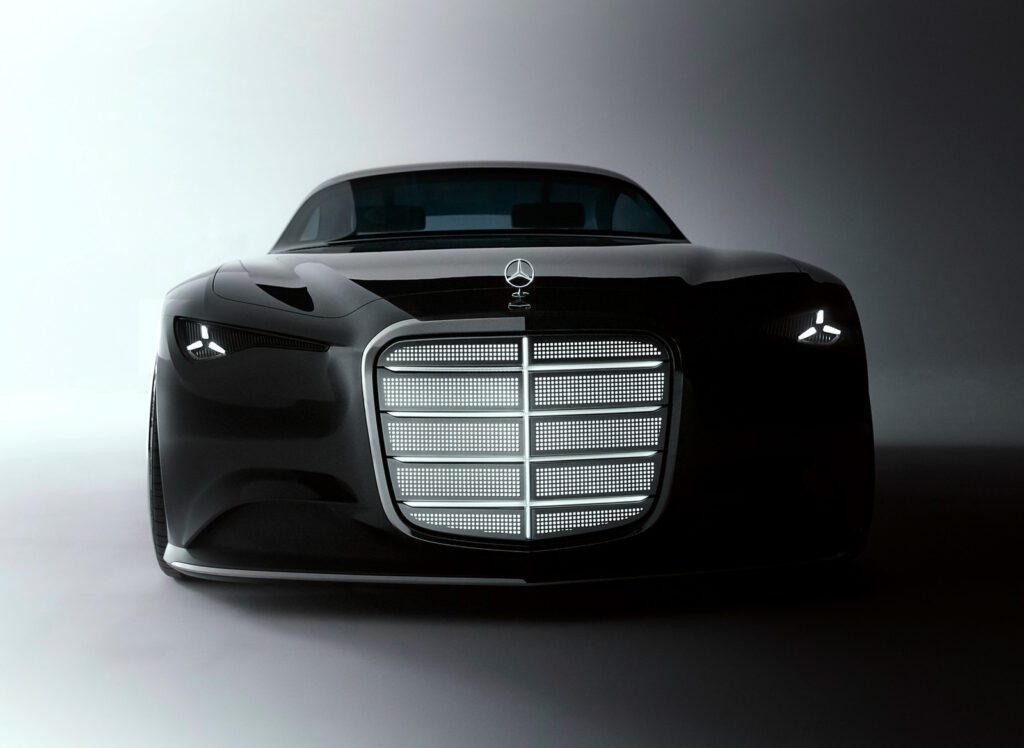
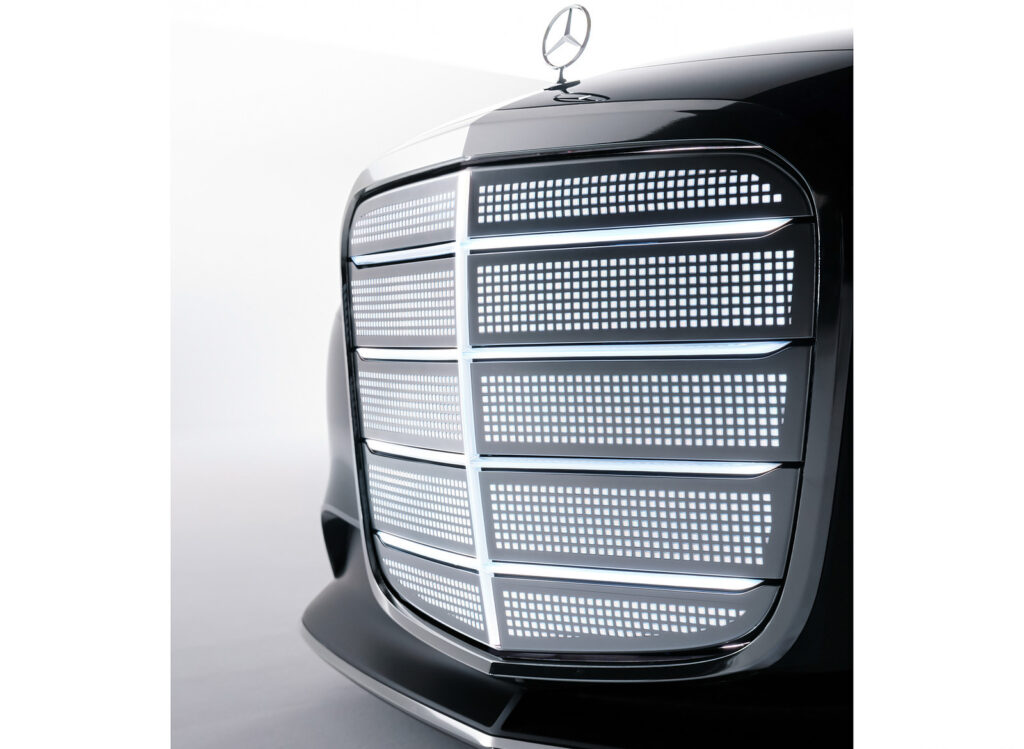
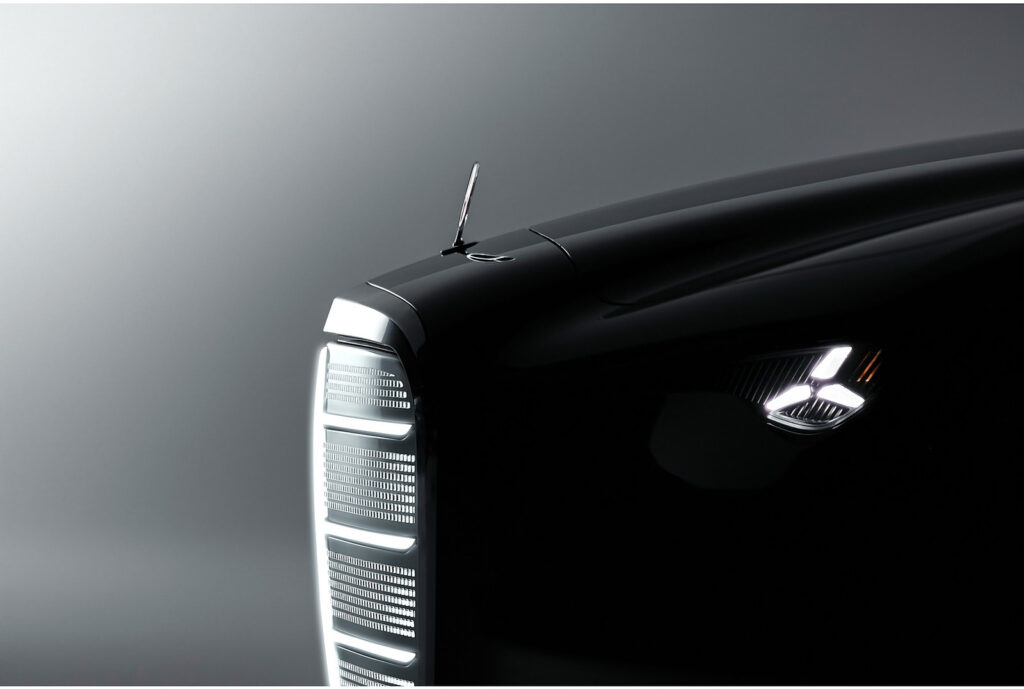
The Vision Iconic centers on a striking, upright radiator-style front end. A wide chrome frame encloses a smoked-glass lattice filled with pixel lighting and subtle contour illumination, while the hood-mounted standing star also glows. Its stance pays homage to upright grilles of classic sedans like the W108, W111, and 600 Pullman, but the slim headlamps, clean surfaces, and modern lighting give it a contemporary edge.
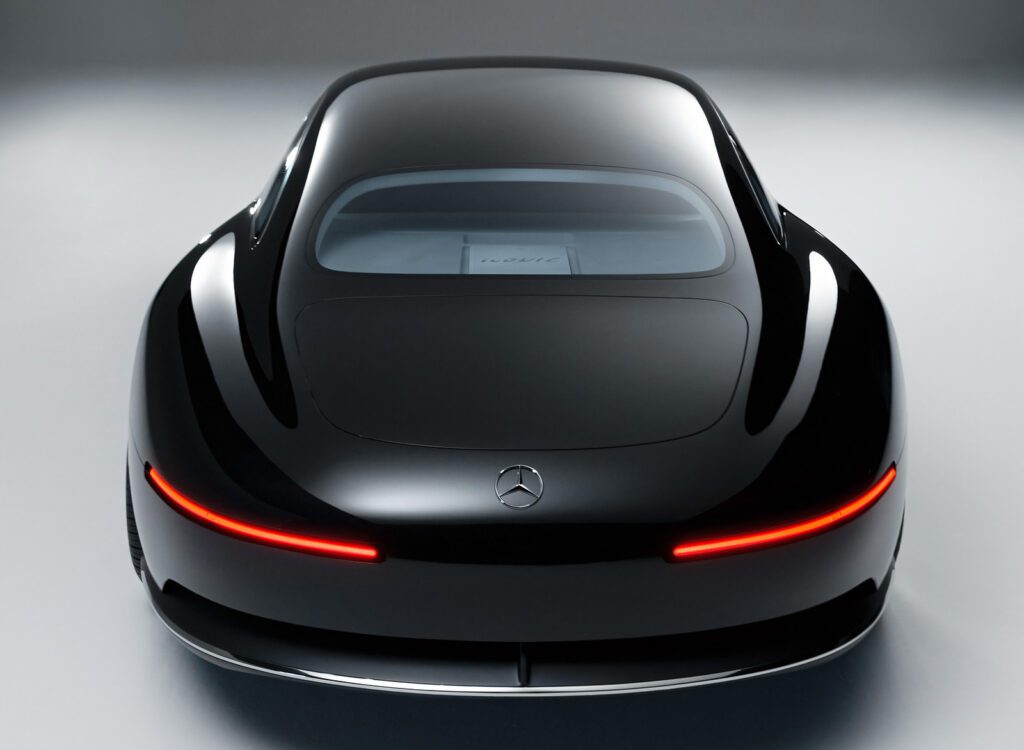
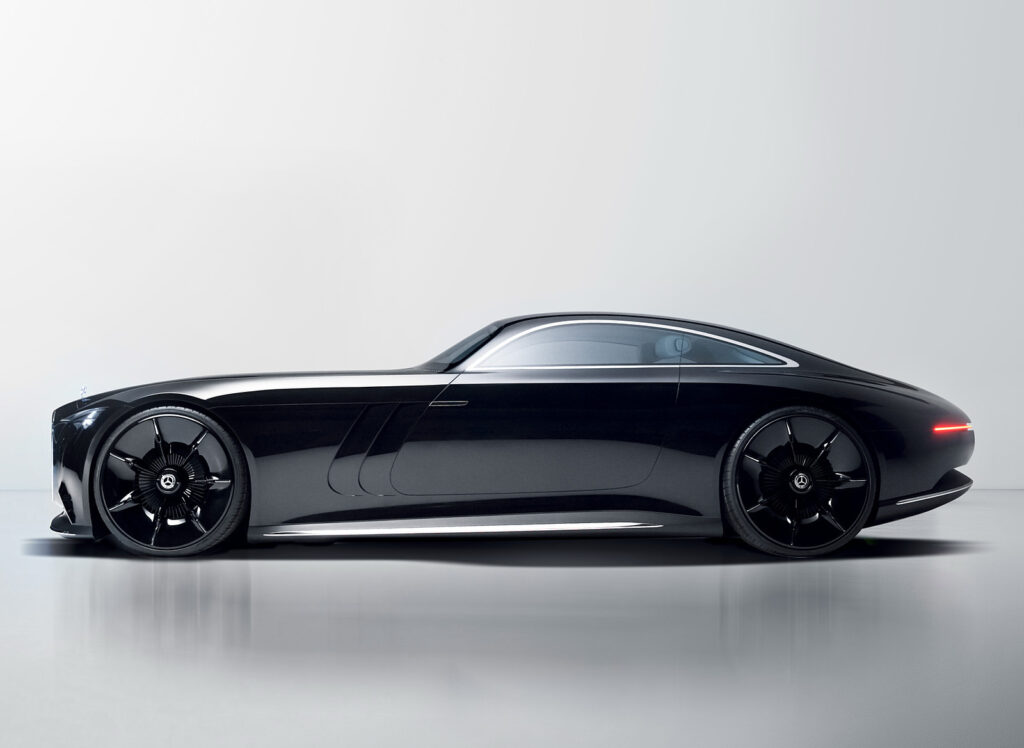
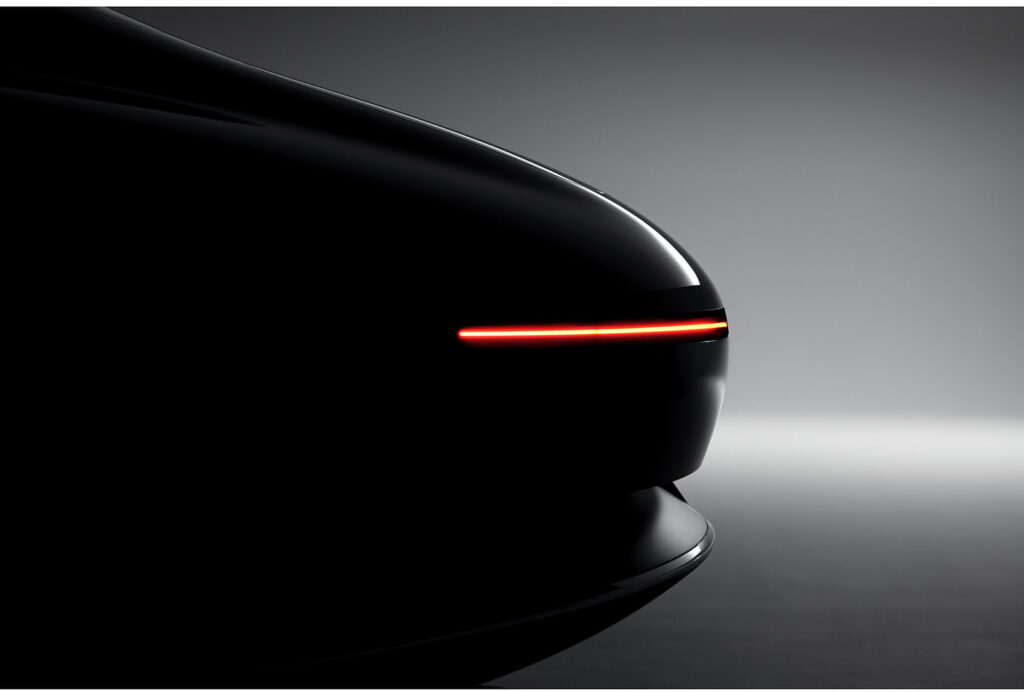
The proportions are long-hood, cab-rearward, with a fastback rear and minimalist tail punctuated by a thin horizontal light strip. The design nods to Mercedes’ golden-era elegance, echoing hints of the 300 SL while reimagined in deep black high-gloss paint with flush detailing. Elements of this new face are already appearing on the upcoming electric GLC, but the Vision Iconic pushes it further, adding animated lighting and an illuminated hood ornament for maximum effect.
Cabin: analog warmth meets digital theater
Inside, the Vision Iconic evokes a lounge-like, tactile atmosphere. A “floating” glass tube spans the dashboard—Mercedes likens it to a Zeppelin—blending traditional instruments with embedded screens. On entry, the gauges animate with a cinematic, mechanical-style motion inspired by high-end watchmaking, before the full pillar-to-pillar display illuminates behind the glass. Four clocks punctuate the dash, including one shaped like the three-pointed star that doubles as an AI companion interface.
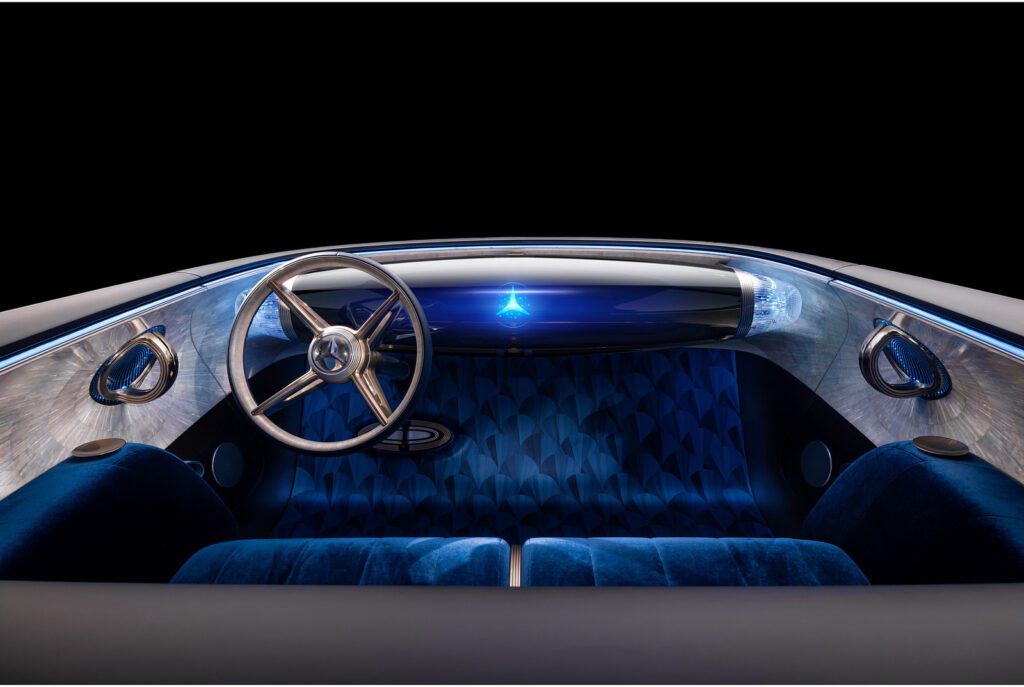
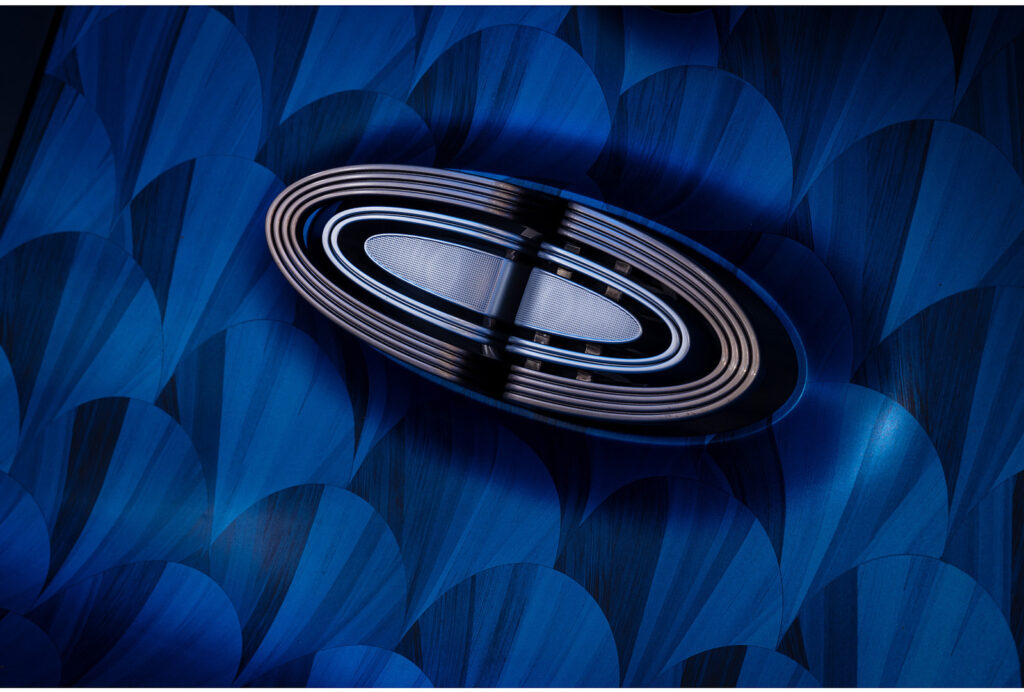
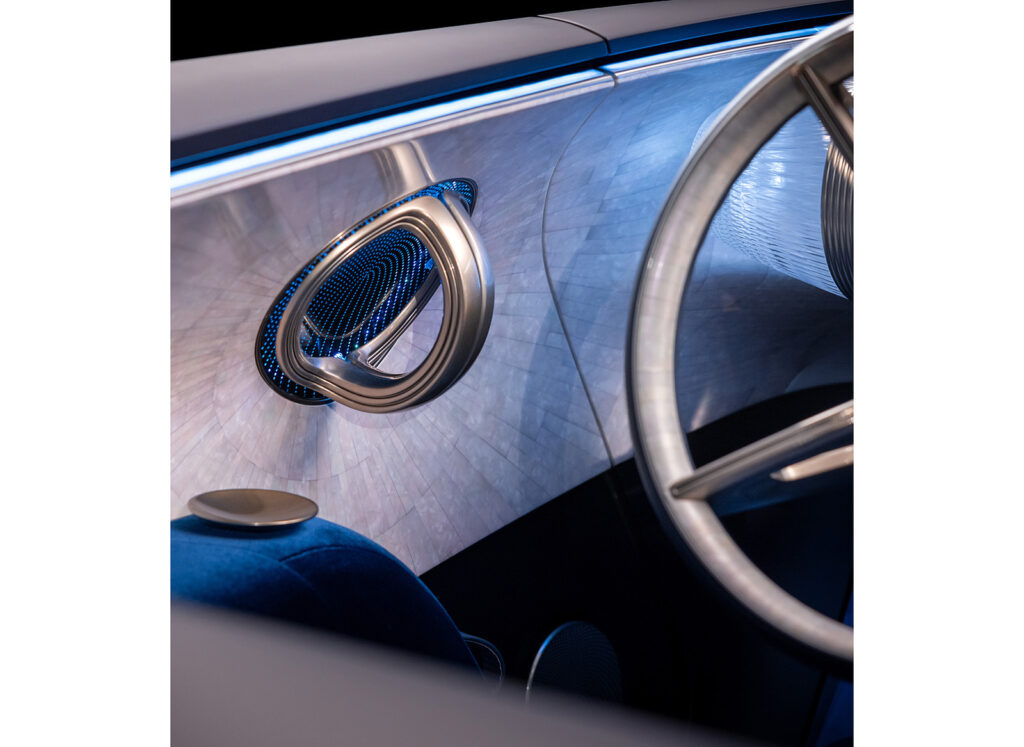
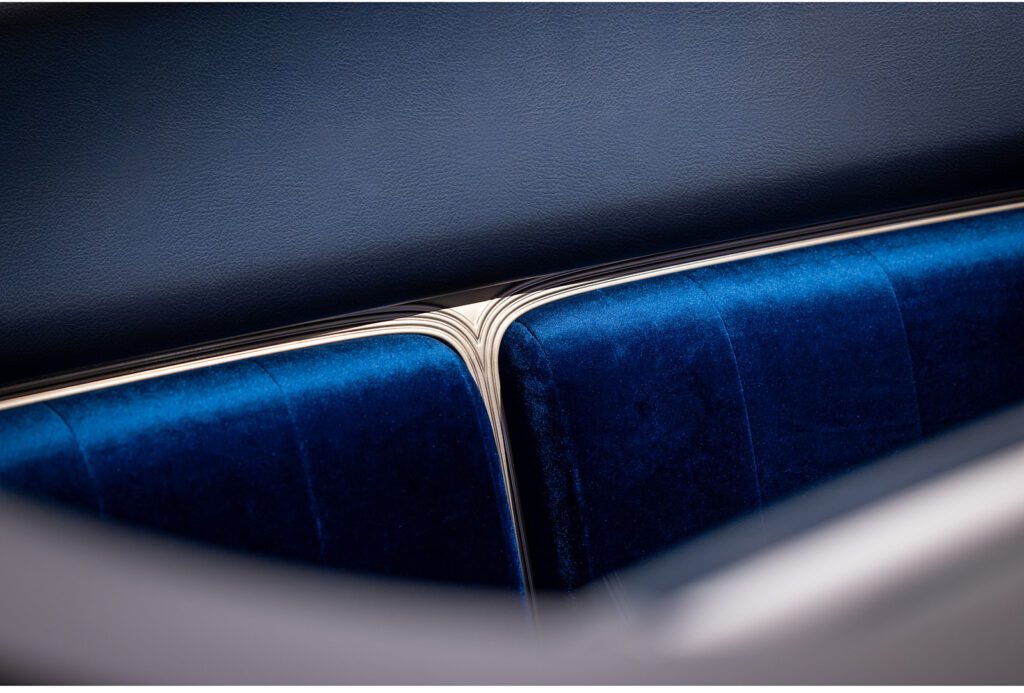
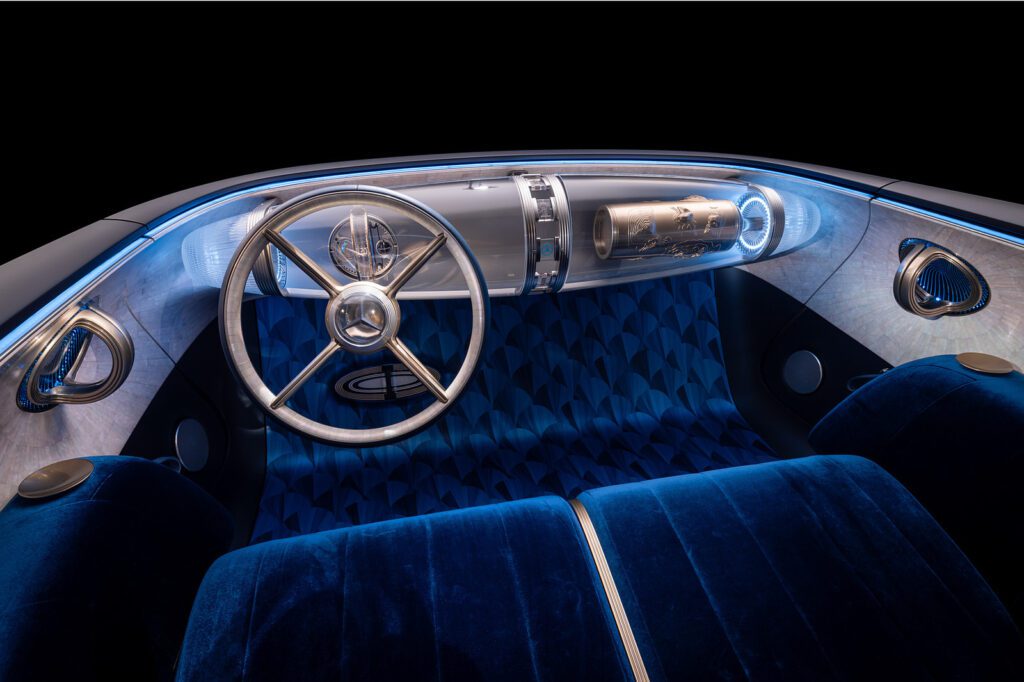
Materials draw heavily from Art Deco influences: a sweeping mother-of-pearl–style inlay extends across the fascia and into the door panels, complemented by polished brass door pulls in a silver-gold finish. A radiant star motif frames the rear seating area. Up front, a deep-blue velvet bench seat replaces conventional buckets, reinforcing the lounge-like ambiance. The four-spoke steering wheel centers a floating brand logo encased in a glass sphere, while the floor showcases straw marquetry laid in a fan pattern—a 1920s craft revived here with furniture-level finesse. The result is exquisite, though the level of detail is the sort of challenge that could make production engineers reach for antacids.
Solar coating: harvesting miles from the sun
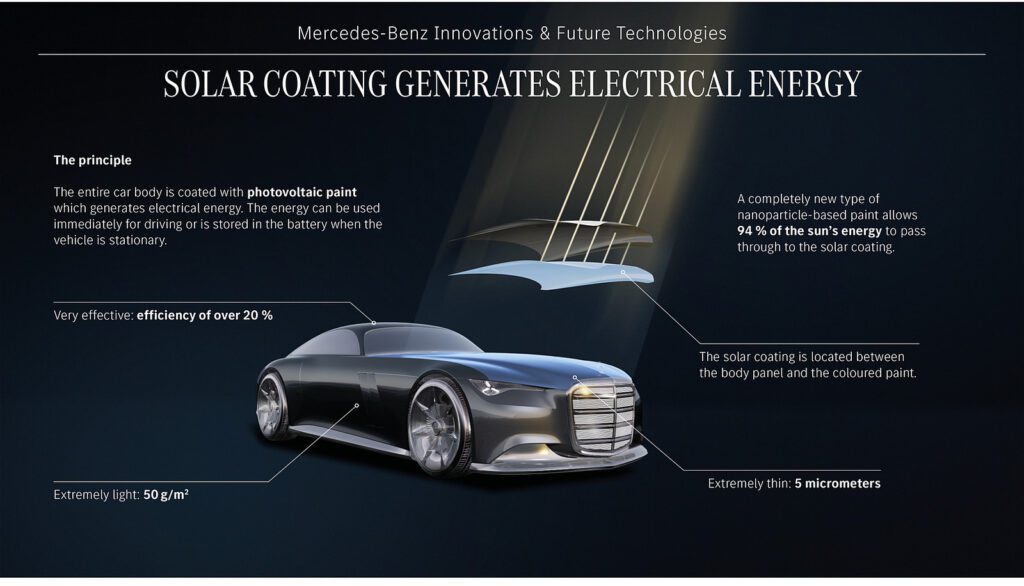
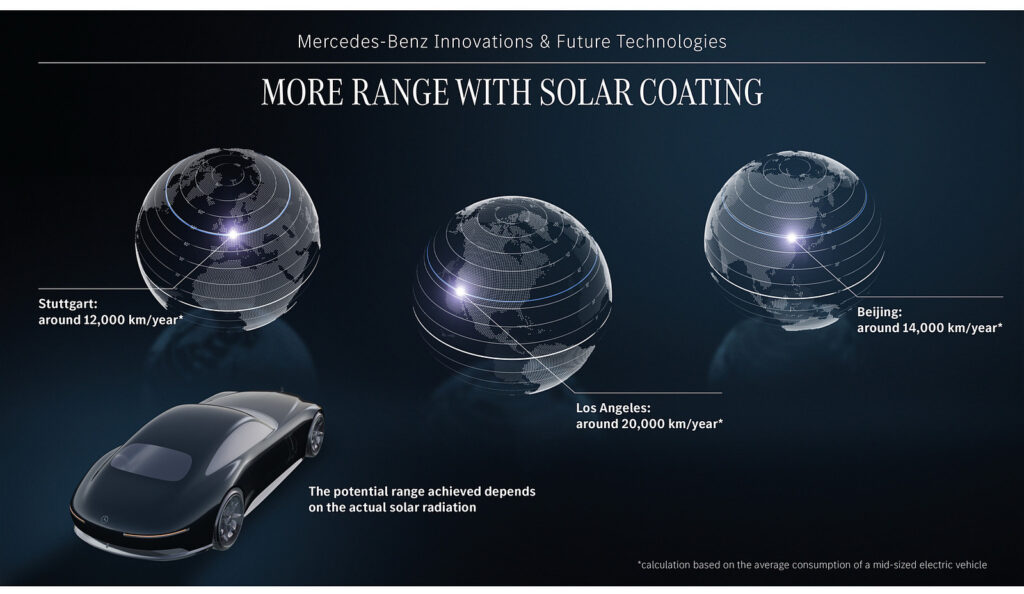
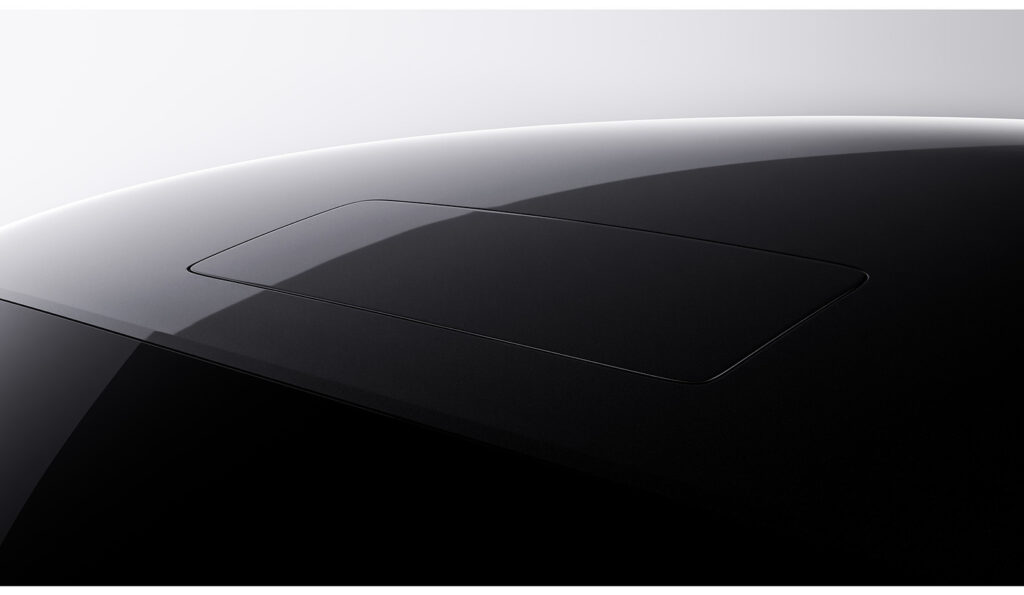
One of the Vision Iconic’s standout innovations is a wafer-thin photovoltaic coating applied across the exterior. Engineered to adhere to multiple surfaces, it continues generating electricity even when the car is parked. Covering roughly 118 square feet—comparable to a midsize SUV—the system is claimed to produce enough energy for up to 7,450 miles of driving annually under ideal conditions. Efficiency is rated at 20 percent, and the chemistry avoids both rare earths and silicon, with recyclability in mind. While the projected mileage assumes ample, unobstructed sunlight—not always realistic in many U.S. climates—the ability to passively recharge while parked remains a compelling, forward-thinking feature.
Brains and bandwidth: neuromorphic computing
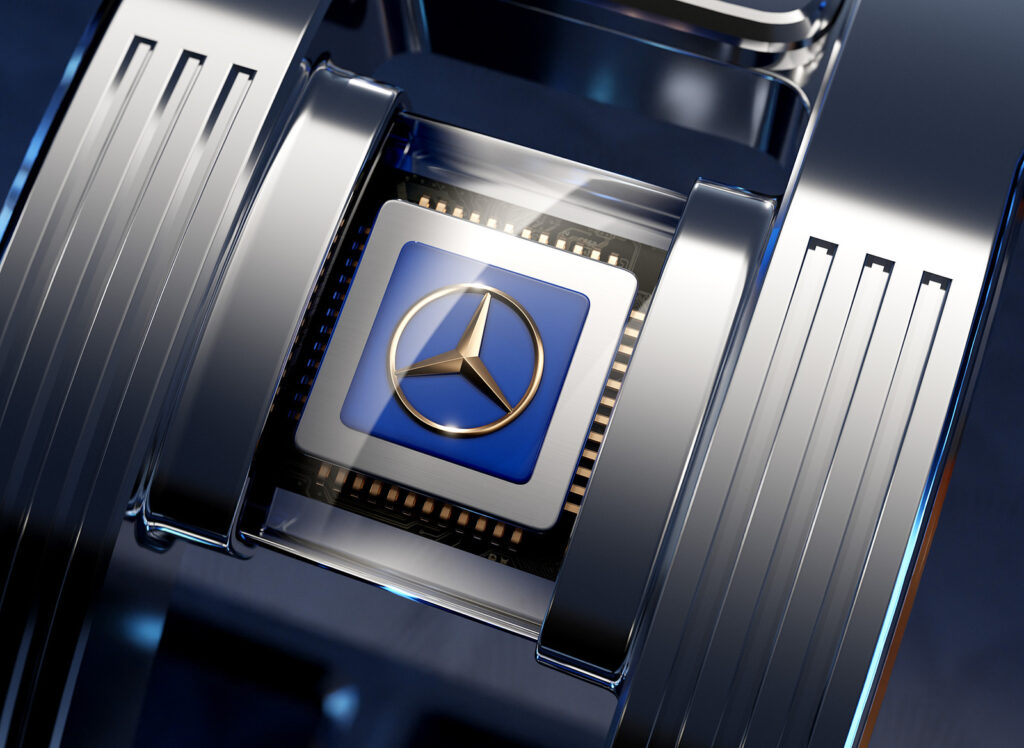
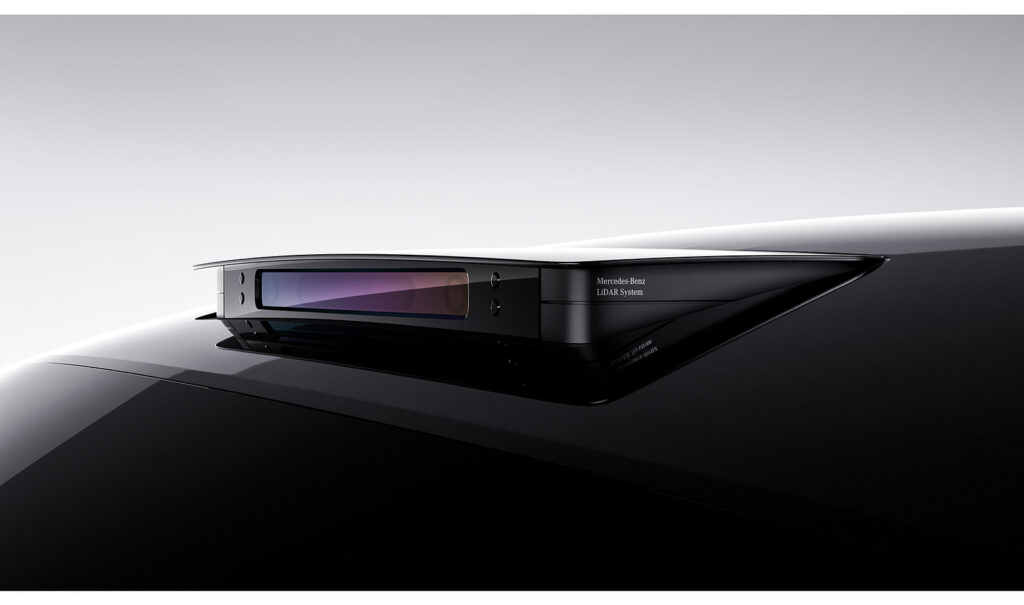
To power increasingly sophisticated driver-assist systems without draining the battery, Mercedes is investigating neuromorphic computing—hardware designed to mimic the way the human brain processes information. The goal is faster perception tasks with drastically lower energy use. Mercedes claims certain AI calculations could become up to ten times more efficient, reducing the power needed for automated-driving data processing by as much as 90 percent compared with current systems. In practical terms, this could mean quicker detection of lanes, signs, and vulnerable road users—especially in low-visibility conditions—while conserving energy. It’s a research initiative, not a production option, but it signals how Mercedes envisions scaling autonomous capabilities without compromising EV range.
Driver assistance today and tomorrow
In the Vision Iconic’s concept framework, advanced Level 2 point-to-point driving in urban traffic is considered standard, using cooperative steering and acceleration to navigate city streets efficiently. Mercedes positions the next step as Level 4 autonomy on limited-access highways, where the driver could completely disengage and let the car manage all aspects of driving. A similarly capable Level 4 automated parking system handles nearly every common parking scenario without anyone in the driver’s seat. For U.S. audiences, the usual disclaimers apply: deployment would hinge on regulatory approval, detailed mapping, and defined operational design domains. Ambitious, yes—but not something achievable with a simple software update.
Steer-by-wire and the long-wheelbase advantage
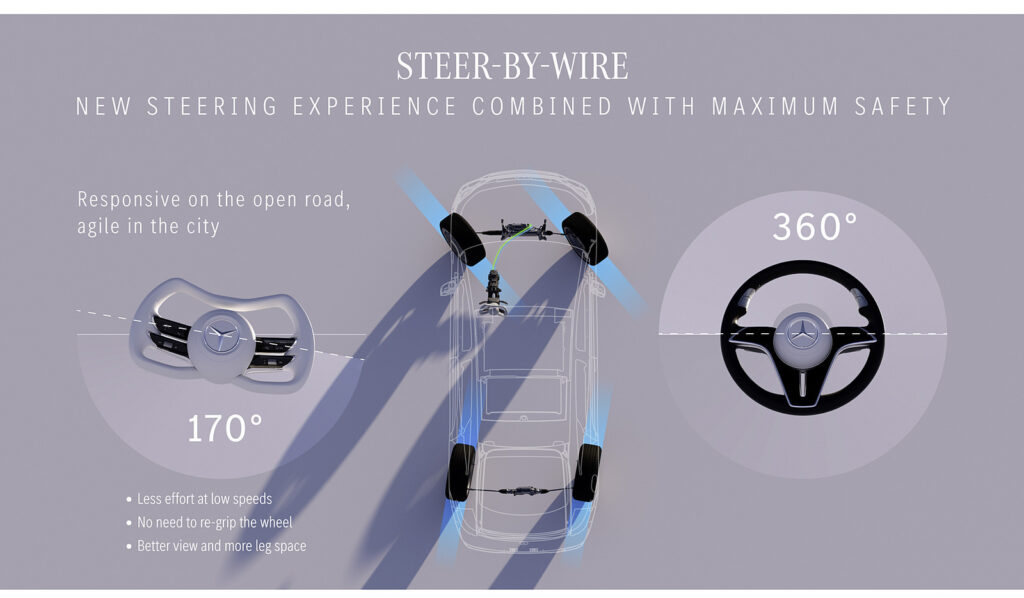
The Vision Iconic replaces a traditional mechanical steering column with steer-by-wire actuators. Combined with rear-axle steering, this system reduces wheel input effort in tight spaces while improving responsiveness on a long-wheelbase vehicle. Eliminating the physical connection also frees up interior packaging—particularly helpful with a wide front bench seat instead of conventional buckets. While steer-by-wire inevitably raises questions about steering feel, the improved maneuverability, especially for parking, is undeniably impressive.
What Mercedes isn’t saying
As a concept, the 2025 Mercedes Vision Iconic comes without traditional specifications. Horsepower, torque, battery capacity, and range remain undisclosed—along with 0–60 mph times, top speed, or pricing. It’s best understood as a design and technology statement, rather than a pre-production prototype.
The fashion capsule and a design book, too
Extending the Vision Iconic’s design language beyond the car itself, Mercedes has created a six-piece capsule collection for men and women. The apparel mirrors the vehicle’s palette—deep blues with silver-gold accents—and echoes the Art Deco geometry seen inside the cabin. The collection debuted in conjunction with Shanghai Fashion Week, where the car made its first public appearance. Mercedes’ design team also produced an ICONIC DESIGN book, detailing this new era with interviews and a sneak peek at another upcoming show car. With the illuminated grille central to this design strategy, expect iterations—already previewed on the upcoming electric GLC—to appear throughout the brand’s portfolio.
The bottom line for the 2025 Mercedes-Benz Vision Iconic
With the Vision Iconic, Mercedes weaves classic elegance together with cutting-edge technology. The upright chrome-and-glass grille, velvet bench, and straw marquetry floor lean into nostalgia, while the solar coating, neuromorphic computing, Level 4 autonomy vision, and steer-by-wire hardware push decisively into the future. Not every detail is destined for production, constrained by crash regulations, durability requirements, or mass-manufacturing realities. Yet as a bold statement of the brand’s vision for electric design—and how it could be powered and processed—the concept lands with unmistakable purpose.